


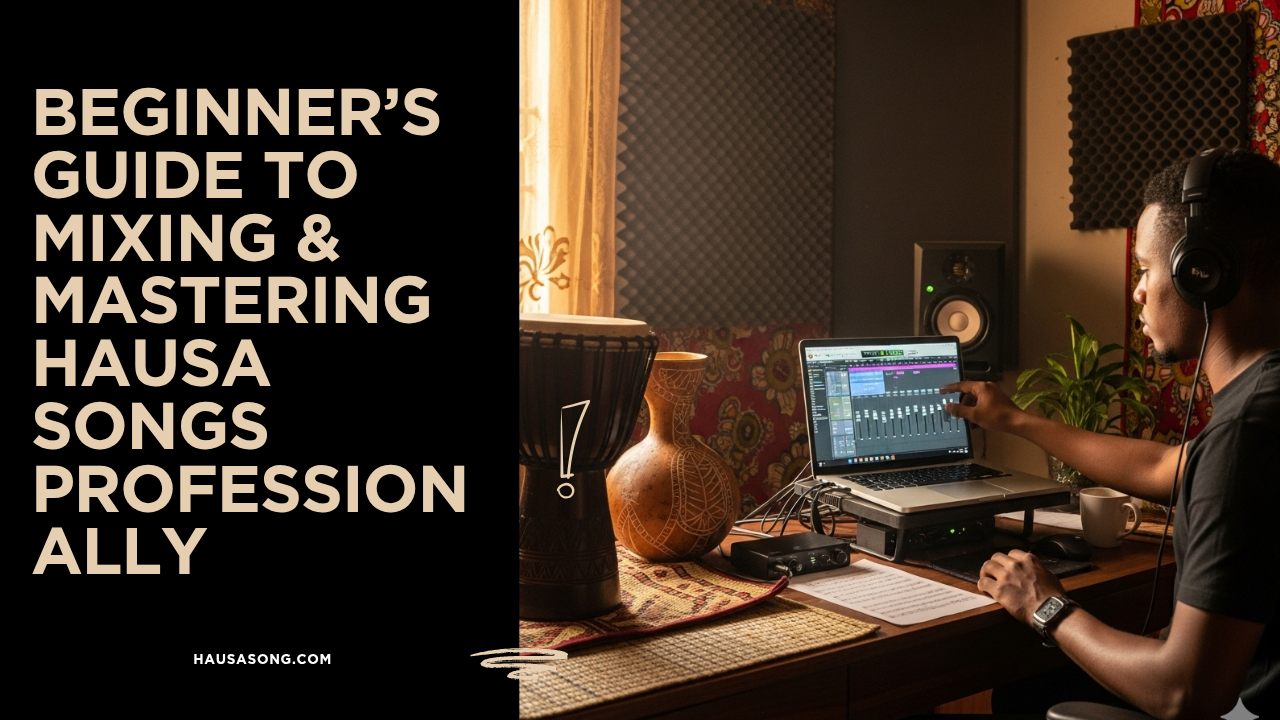
A few years back I helped a friend from Kano finish a wedding single. We recorded his voice under a ceiling fan in a small room. The take had heart but also hiss and a shaky low end. We spent the night cleaning the track, shaping the vocal, and sitting the accordion and talking drum under the voice. When the song played at the reception the whole family stood up and danced. That night taught me two things. Good songs can be rescued with careful work. And a clear, simple workflow wins every time. Nagode to the bride and groom for the free jollof.
Why this guide matters
If you want to mix Hausa songs and master Hausa music that sound ready for radio and streaming you do not need expensive gear. You need a workflow you trust and the skill to follow it. This guide is practical and step by step. It is written for Arewa artists and producers who want results fast and results that last.
Recommended article for you: Best Free & Paid Beat-Making Software for Hausa Producers
1. Planning and prep — before you open the DAW
Good mixes start before the first plug-in. Do these first.
- Choose a reference track that matches your target. Pick a Hausa or Afrobeats track you admire.
- Label tracks and keep the session tidy. Name every vocal take, drum, and instrument.
- Set a project sample rate and bit depth. 44.1 kHz and 24-bit is fine for most releases.
- Make a bleed plan for live instruments. Note which mics and rooms you used.
- Export clean stems of problem takes. Keep originals untouched.
Practical tip for Arewa artists
Record a short demo to test the vocal chain and room. If you can, record vocals in a wardrobe or behind a blanket to reduce reflections. The voice is the centre for most Hausa songs so protect it.
2. Gain staging and session setup
Start with good levels so processing behaves predictably.
- Import stems and set each track so the peak meters sit around -18 dB FS. This gives headroom for processing.
- Create a “Mix Bus” set to unity gain. Do not put mastering processing here yet.
- Add a reference track to your session and match loudness roughly with gain automation. This keeps your ear honest.
- Save a session version before heavy edits.
Why -18 dB FS
This is a standard working level. It keeps your plugins from over-reacting and leaves room for the mastering stage.
3. Mixing vocals and lead instruments — step by step
The voice carries the lyrics and emotion in Hausa songs. Treat it like a person on stage.
Step 1. Clean the vocal
- Use a noise gate or manual editing to remove background noise between phrases.
- Apply gentle de-noise only when necessary. Avoid making the voice sound synthetic.
Step 2. EQ the vocal
- High pass at 80 to 120 Hz to remove rumble.
- Cut boxy frequencies around 200 to 400 Hz if the vocal sounds muffled.
- Boost a small shelf around 5 to 8 kHz for presence and clarity. Use narrow boosts sparingly.
Step 3. Compression
- Use fast attack and medium release for level control.
- Ratio 3:1 to 4:1 is a good start.
- Aim for 3 to 6 dB of gain reduction on louder phrases.
Step 4. De-essing
- Place a de-esser where sibilance is harsh. Target 5 to 9 kHz depending on the voice.
Step 5. Add character with parallel processing
- Send the vocal to a parallel bus.
- Apply heavier compression on the parallel bus and blend in to taste for body without destroying dynamics.
Step 6. Effects for space
- Use a short plate reverb and a timed delay to sit the vocal in the mix.
- For call-and-response parts use a slightly drier vocal for the lead and wetter for backing lines.
Practical tip for Hausa phrasing
Many Hausa lines contain fast runs and call-and-response. Use automation to ride volume during runs. Keep call responses slightly lower so the lead cuts through.

4. Arrangements and spatial treatments
Hausa songs can have dense percussion, shakers, talking drums, and traditional instruments. Balance is key.
Static separation
- Carve space early with subtractive EQ. Give each instrument a frequency area to live in.
- Use panning for percussion and backing vocals. Keep low end narrow.
Low end control
- Use a gentle high pass on everything except bass and lowest percussion.
- Tighten kick and bass with sidechain compression if needed. Duck bass under the kick so the groove is solid.
Stereo field
- Keep lead vocal, kick, and bass in the center.
- Spread instruments like guitars, shakers, and backing vocals wider. Small delays and reverb pre-delay can create depth without blurring the mix.
5. Bussing, group processing, and automation
Treat instrument groups as single entities to work faster and create cohesion.
- Create buses for drums, percussion, synths, strings, and backing vocals.
- On each bus, use light compression for glue. Too much makes the mix lifeless.
- Use EQ on buses to shape the overall tone. For example, gentle high-shelf on backing vocals to add air.
- Automate rides for verses and choruses. Automation is more important than extra plugin chains.
Mix checklist for Arewa songs
- Are the verses intelligible lyrically
- Does the chorus hit emotionally
- Are traditional instruments audible and not masked
- Is the low end tight across different playback systems
6. Mastering basics for Arewa releases
Mastering makes the song competitive. It does not fix a bad mix. Keep the master chain simple.
Step 1. Prepare the mix
- Export the final mix with -6 dB peak headroom. This gives mastering chain room to work.
Step 2. Mastering chain example
- High pass filter at 20 to 30 Hz to remove inaudible rumble.
- Gentle broadband EQ to correct tonal balance.
- Multi-band compression to control harsh bands or tame resonances.
- Stereo imaging modestly widened on mid-highs only if needed.
- Peak limiting to reach target loudness.
Loudness targets
For streaming platforms aim for integrated LUFS between -12 and -14 depending on platform. If you need the song louder use careful limiting and avoid clipping.
Final checks
- Listen on headphones, nearfield monitors, and phone speaker.
- Check in mono. If the song collapses badly in mono, fix phase issues.
- Export final master at 16-bit 44.1 kHz for distribution and keep a 24-bit master for archiving.
Practical mastering advice
If you are new, hire a mastering engineer for your first few releases. Compare their masters to your mixes and learn from the changes.
7. Case study — Zahra Danladi, an Arewa song from demo to release
Zahra is a singer from Kaduna. She recorded her song in a small home studio. Here is how the project moved from raw tracks to release.
Recording notes
- Two vocal takes, one main and one harmony.
- Talking drum and guitar recorded live.
- Beat made in a laptop using local drum samples.
Mixing workflow used
- Session gain staged to -18 dB FS.
- Vocal cleaned and a gentle de-noise applied.
- Main vocal EQed: HPF at 100 Hz, cut 300 Hz by 2 dB, mild presence boost at 6 kHz.
- Parallel compression added to the vocal to add body.
- Talking drum given a short room reverb and panned slightly left.
- Guitar treated with mid-side EQ to create space.
- Bus compression on drums at 1.5 dB of gain reduction.
Mastering
- Mix exported at -6 dB peaks.
- Master chain had gentle multiband compression and a limiter to reach -13 LUFS.
- Final checks on phone and laptop.
Result
The final track played well on local radio and sounded punchy on Bluetooth speakers. Zahra learned the value of clean vocal takes and saving stems for later edits.
8. Expert and fan quotes
“A good mix tells the song where to breathe. Don’t over-process. Start simple.”
— Aisha Musa, Mix Engineer, Kano
“I want a vocal that cuts through in traffic and on small speakers. That is the real test.”
— Sani Bello, Arewa producer
“When my uncle heard the mastered track in his car he asked who mixed it. That is when you know you did something right.”
— Fatima, fan and radio host, Zaria
These quotes reflect the kind of practical feedback you will hear in our scene.
9. Practical plugin chain and settings cheatsheet
Use this as a quick reference.
Vocal channel
- High pass 80 to 120 Hz
- Subtractive EQ 200 to 400 Hz cut 1 to 3 dB
- Compressor ratio 3:1, attack 10 ms, release 60 to 120 ms, gain reduction 3 to 6 dB
- De-esser 6 to 8 kHz
- Parallel compressor bus with heavy compression and blend 10 to 30 percent
- Short plate reverb, pre-delay 20 to 40 ms
Drum bus
- Light compression, 1.5 to 3 dB gain reduction
- Gentle transient shaper if required
- Bus EQ lift at 2 to 4 kHz for attack
Master bus
- High pass 20 to 30 Hz
- Subtle gentle EQ shaping
- Multi-band compressor if low end needs control
- Limiter with 1 to 3 dB of gain reduction for masters aimed at streaming
10. Actionable insights — what you can do today
- Record a 60 second vocal test and mix it with the steps above. Compare to a reference track.
- Save three different versions of the vocal with different EQ moves. Choose the best one after a break.
- Export a mix with -6 dB headroom and test on at least three playback systems.
- Learn one plugin well. Master one compressor and one EQ first.
- Join a local producer group and ask for feedback on one track.
11. FAQ
Do I need an expensive mic to mix Hausa songs professionally?
No. Good technique and a clean room make a bigger difference than a top mic. A reliable dynamic or budget condenser will do well if used correctly.
What loudness should I aim for when I master Hausa music?
Aim for around -12 to -14 LUFS integrated for most streaming platforms. If you want the track louder be careful with limiting to avoid distortion.
How do I make traditional instruments sit with modern beats?
Give each instrument its own frequency space with subtractive EQ. Use panning and short delays to separate textures. Keep the low end for bass and kick.
Should I mix in headphones or monitors?
Use both. Headphones reveal detail while monitors show how the low end translates. Check on Bluetooth speakers and phones too.
Can I master my own tracks?
Yes for demos and learning. For a commercial single consider a mastering engineer. A fresh pair of ears catches things you will miss.
12. Call to action na Karshen magana
Which part of the mix do you struggle with most? Drop the name of a track or a screenshot of your session in the comments. Share this guide with an Arewa artist who needs it. If you want, send a short stem and I will point out three quick fixes you can do today.
More Updates

Best Streaming Platforms for Upcoming Hausa Artists in 2025

How to Create Your First YouTube Music Channel as a Hausa Artist

Why Hausa Love Songs Still Dominate the Charts in Northern Nigeria

The Need for More Hausa Music Awards & Recognition Platforms

Case Study: How One Arewa Artist Built Fame with Audiomack Alone